
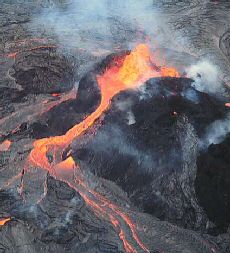
History profs may need to thoroughly revise their lecture notes after a Cornell University radiocarbon study, published in the latest issue of Science, found evidence that disputes some commonly held assumptions about Aegean and Near Eastern civilization trade links at the beginning of the Bronze Age. Researchers claim that they have evidence that an infamous volcanic eruption occurred 100 years earlier than current records show, and suggest that a realigning of Aegean and Egyptian chronologies by 100 years is in order. This is a highly significant development, as it would make possible Mediterranean cultural alliances that previously seemed impossible.
After examining tree rings and seeds, researchers now believe that the Santorini volcanic eruption – an important historical marker – occurred in the late 17th century B.C., and not 100 years later as records currently show (oops!). This development may have important implications for histories that claim that the seafaring Minoans of Crete, the mercantile Canaanites of northern Egypt and the Levants never had trade relations, as they were separated by 100 years.
The exact date of the eruption has never been known, yet scientists have used Santorini, one of the largest eruptions in history, as an important archaeological signpost. Taking this into consideration it’s easy to see how the discrepancy arose, as scientists used the eruption to link Aegean styles in trade goods found in Egypt and the Near East to Egyptian inscriptions and records. “Santorini is the Pompeii of the prehistoric Aegean, a time capsule and a marker horizon,” said Manning. “If you could date it, then you could define a whole century of archaeological work and stitch together an absolute timeline.”
Manning and his colleagues rose to this challenge and set about analyzing 127 radiocarbon measurements from samples such as tree-ring fractions and seeds harvested in Santorini, Crete, Rhodes and Turkey. After analyzing the samples, Manning was able to allocate accurate dates to cultural periods during the Late Bronze Age.
While previous guesstimates placed the volcanic event around 1500 B.C., Manning found that the Santorini eruption actually occurred in or around the period 1660 to 1613 B.C. “At the moment, the radiocarbon method is the only direct way of dating the eruption and the associated archaeology,” said Manning.
The solution, Manning suggests, is that Aegean and Egyptian chronologies for the period 1700-1400 B.C. be realigned. Manning sees a number of weak links in the chronology, and views the new radiocarbon data as grounds for “a critical rethinking of hypotheses that have stood for nearly a century in the mid second millennium B.C.”
The chronologies of the Aegean and Near Eastern cultures have been a crucial anchor point in regard to Greek and European history, so any alteration will have a significant flow-on effect. In short, the “realignment” means that Aegean chronology will be extended by 100 years, and reveal alliances and cultural influences that have until now seemed highly improbable.
Manning’s findings are given further weight by Danish geologist Walter Friedrich, who founded the Aegean Dendrochronology Project 30 years ago. Friedrich’s own study also found that the Santorini eruption occurred around late 17th century B.C.

















Comments are closed.