
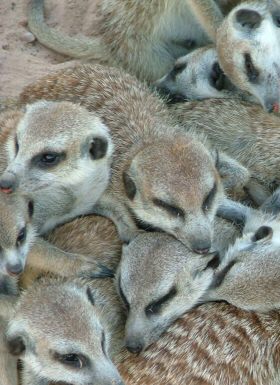
Peacock tails, the antlers of a bull elk and the lion’s mane have all evolved in male animals thanks to competition for reproductive success. These products of sexual selection were typically found only in male animals but it now seems that sexual selection is also alive and well in female meerkats.
In the journal Nature, Earthwatch sponsored researchers describe how female meerkats compete more intensely than males for breeding opportunities. These behaviors result in characteristics more often found in males, such as an increase in size, aggressiveness, and testosterone level.
“Meerkats are ideal models for exploring sexual selection independent of parental investment, because they are cooperative breeders,” said Prof. Timothy Clutton-Brock, principal investigator of Earthwatch’s Meerkats of the Kalahari project. Meerkats breed cooperatively in groups of 3 to 50 where all of the members of that group work together to raise and protect their pups, most of which are the offspring of the dominant pair. Past research suggested that males were the object of sexual selection because they usually invested less energy in their offspring than their female counterparts. Without the full-time job of rearing their young, males are more often free to strut and shove and preen to maximum effect.
Clutton-Brock suggests that these findings call for an examination of definitions of sexual selection. Current use tends to emphasize competition between males for mates. The alternative proposed by the authors is to return to Darwin’s description that involves competition for reproductive opportunities, a broader definition that could include competition between cooperatively breeding females.
Related articles:
For Some Females, Size Does Matter
Researchers Investigate Giant Sperm Paradox
Sexual Success And The Schizoid Factor
Source: Earthwatch Institute
Pic courtesy Diane Troppoli/Earthwatch Institute











Comments are closed.