
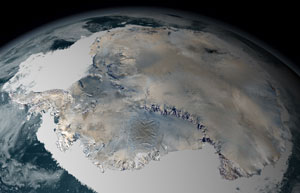
The total or partial collapse of the West Antarctic Ice Sheet would not raise global sea levels as high as predicted contends a new study, but the effects would be most strongly felt in coastal areas of the United States.
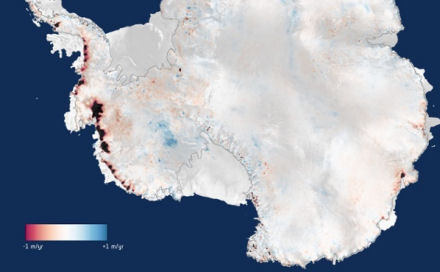
Antarctica holds about nine times the volume of ice of Greenland and its western ice sheet (WAIS) is of particular interest to scientists due to its inherent instability, a result of large areas of the continent’s bedrock lying below sea level. But the ice sheet’s potential contribution to sea level rise has been greatly overestimated, according to new calculations.
“There’s a vast body of research that’s looked at the likelihood of a WAIS collapse and what implications such a catastrophic event would have for the globe,” said Jonathan Bamber, lead author of the study published in Science. “But all of these studies have assumed a 5-meter to 6-meter contribution to sea level rise. Our calculations show those estimates are much too large, even on a thousand-year timescale.”
According to theory, if these floating ice shelves were removed, sizeable areas of WAIS would essentially become undammed, triggering an acceleration of the ice sheet toward the ocean and a rapid inland migration of the grounding line. The grounding line is the point where the ice sheet’s margins meet the ocean and begin to float.
The most unstable areas of WAIS are those sections sitting in enormous inland basins on bedrock entirely below sea level. If the ice filling these basins becomes undammed by the disappearance of floating ice shelves, it quickly would become buoyant and form new floating ice shelves further inland, in time precipitating further breakup and collapse, according to existing theories.
The study authors assumed that only ice on the downward-sloping and inland-facing side of the basins would be vulnerable to collapse. They also assumed that ice grounded on bedrock that slopes upward inland or on bedrock that lies above sea level likely would survive. “Unlike the world’s other major ice sheets – the East Antarctic Ice Sheet and Greenland – WAIS is the only one with such an unstable configuration,” said Bamber.
Just how rapid the collapse of WAIS would be is largely unknown. If such a large mass of ice steadily melted over 500 years, as has been suggested in earlier studies, it would add about 6.5 millimeters or a quarter of an inch per year to sea level rise – about twice the current rate due to all sources.
“Interestingly, the pattern of sea level rise is independent of how fast or how much of the WAIS collapses,” Bamber said. “Even if the WAIS contributed only a meter of sea level rise over many years, sea levels along North America’s shorelines would still increase 25 percent more than the global average.”
Regional variations in sea level would largely be driven by the distribution of ice mass from the Antarctic continent to the oceans, according to the study. With less mass at the South Pole, Earth’s gravity field would weaken in the Southern Hemisphere and strengthen in the Northern Hemisphere, causing water to pile up in the northern oceans. This redistribution of mass also would affect Earth’s rotation, which in turn would cause water to build up along the North American continent and in the Indian Ocean.
Related:
Climate “Tipping Points” Identified
Glacier Woes Overstated?
West Antarctic Ice Sheet Gets Climatologists Hot And Bothered





Comments are closed.